

1948 Vienna
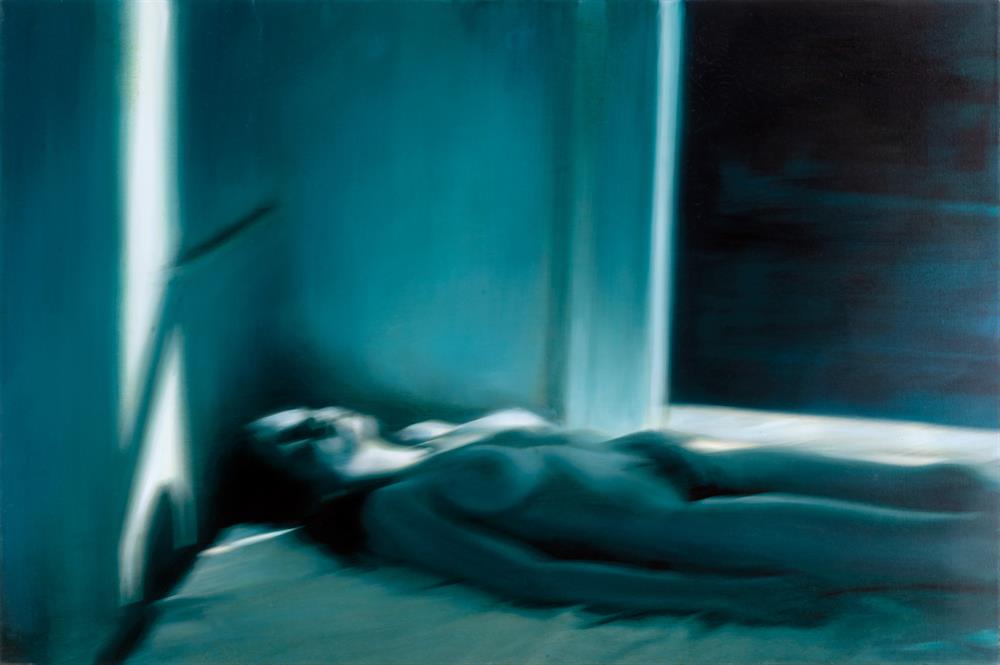
"Danae Waiting for the Rain II"
from the series "Paradise Burning"Oil and acrylic on canvas
101.6 x 152.4 cm
Signed and dated on the reverse: G Helnwein / 2003
Labels on the reverse of the gallery Modernism, San Francisco, California as well as of the gallery Sho, Tokyo, Japan
Provenienz:
Gallery Modernism, San Francisco, California
Gallery Sho, Tokyo, Japan
Private collection, Japan
Ausstellungen:
San Francisco, Gallery Modernism, 2003
Gottfried Helnwein (b. 1948) is one of the most significant contemporary Austrian artists. Since the early 1970s, his multifaceted body of work has explored human vulnerability, the mechanisms of violence, memory, and power, as well as the media’s construction of reality. Helnwein first gained international recognition for his hyperrealistic depictions of injured children, which became symbols of a postwar society marked by trauma. In the decades that followed, he expanded his artistic range to include large-format paintings, photographs, and installations in which art-historical, literary, and mythological motifs merge with contemporary visual worlds.
“Danaë Waiting for the Rain II” alludes to one of the most famous tales in Greek mythology. Danaë, daughter of King Acrisius of Argos, was locked away by her father in a bronze tower after an oracle had prophesied that his grandson would one day kill him. Yet even this isolation could not stop fate. Zeus approached Danaë in the form of a golden rain and fathered the future hero Perseus with her. Since the Renaissance, the myth has been depicted countless times—mostly as a symbol of divine seduction, feminine beauty, and erotic devotion. Artists such as Titian, Correggio, Rembrandt, and Gustav Klimt interpreted the golden rain as a radiant symbol of divine presence and fertility.
Helnwein, however, strips this iconographic tradition of all sensual opulence. His Danaë lies motionless on a bed, bathed in a cool, bluish shimmering light. The expected shower of gold fails to materialize—instead, a state of waiting, silence, and uncertainty prevails. The blurred contours lend the scene a dreamlike quality, as if it were suspended between memory and vision. It is precisely in this state of limbo that the painting unfolds its particular tension: the focus is not on the divine moment itself, but on the pause that precedes it. Helnwein transforms the ancient myth into a timeless meditation on anticipation, longing, and the inescapable workings of fate—themes that resonate far beyond their mythological origins into the present day.