


Innsbruck 1932 - 2011 Wien
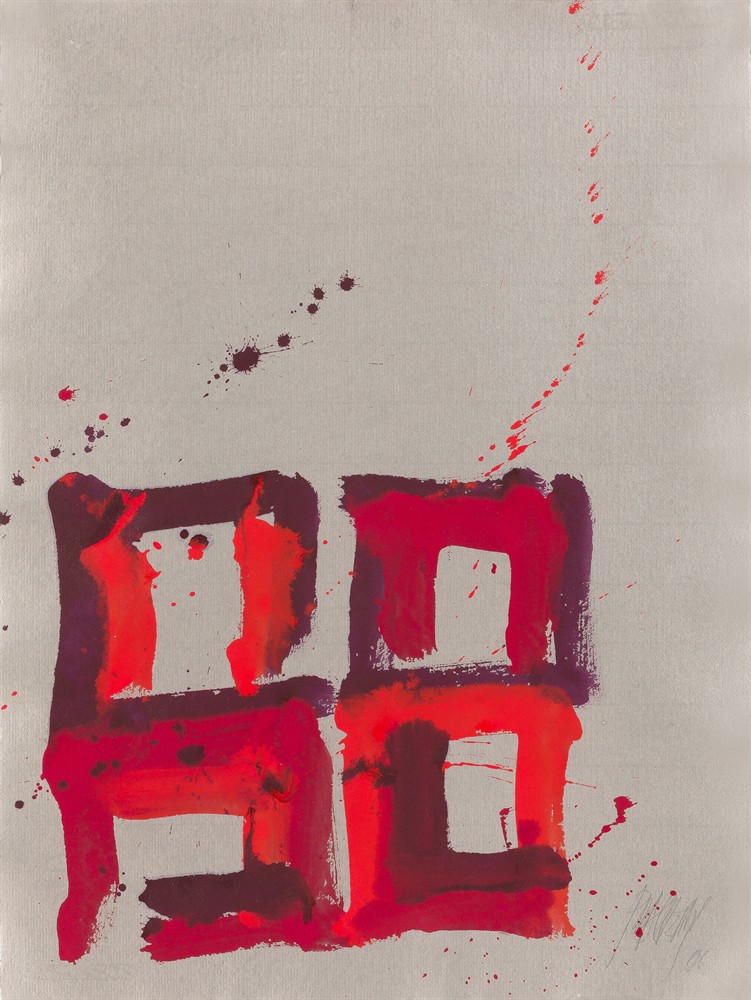
"Farnesina Dixie"
Acrylic on paper
79 x 59 cm
Signed and dated lower right: PRACHENSKY 06
Literatur:
cf. Exhibition catalogue "Prachensky. Frühe und späte Werke", Essl Museum, Klosterneuburg/Vienna 2007-08, ill. p. 104f.
“It’s about writing. About calligraphy. The images want to be read. The indecipherable nature of the symbols wants to be understood. No. It’s about emotional gesture. About spontaneity. It’s about power and energy, not deliberation and calculation. No. It’s about architecture. That is, about construction. About statics and unshakable solidity. About the harmony of the parts. About propositions. It’s about all of this and yet something entirely different. Prachensky’s paintings deal with the drama of existence. With its tragedy. And also with its comedy. For life is both cheerful and serious, comical and yet always bloody. Right to the very end.”
No other body of work is as deeply shaped by the artist’s architectural understanding as “Imperium Romanum,” created between 2004 and 2006 following several trips to Rome and an intensive engagement with Roman history and architecture. The body of work consists of several series: “Senatus Populusque Romanus,” 2004; “Senatus Consultum,” 2005, and “Farnesina Dixie,” 2006. What he saw and experienced flows into these paintings. We discover echoes of Roman architecture—temples and palaces, excavations and ruins—that have stood the test of time thanks to their magnificent construction. Markus Prachensky transforms his memories of these sites into his gestural painting. He translates his sense of the structural elements and the laws of construction in ancient architecture into column-like bands of color, arches, and tympanum-like elements. With the monochromatic black backgrounds in the “Senatus Consultum” series, he further enhances the luminosity of the red tones that dominate all his works. In “Farnesina Dixie,” the somewhat more cheerful and playful forms stand out against a gray background—a reminiscence of the frescoes in the Casa della Farnesina in Trastevere, which Agrippa, a friend and companion of Augustus, had built, and which feature a background of the same color. This loosening of the composition may also be related to the influence of Dixieland jazz, which subconsciously found its way into the painting of this series.
The artist himself best describes just how profoundly the impressions of Rome—which he has visited time and again since the early 1980s—have shaped his work: “Right from the start, I knew this city would swallow me whole—and it did. I remained as a lover and painter of Rome and, I believe, as a chronicler of Rome from my own perspective [....] No matter where in the world I happened to be, I’ve lived in Rome since my youth. Now I live in Rome, even though I’m in Vienna and paint here; here I happily soak up Rome, the Romans, Roman cuisine, drink Roman wines, read about the history of the Roman Empire and the Roman worldview, and am glad I don’t have to be a strict and austere Greek.”
1 Klaus Albrecht Schröder, in: Exhibition catalog “Markus Prachensky. The French Paintings,” Galerie Ulysses, Vienna 2010, [n.p.]
2 Markus Prachensky, 2004, in: Exhibition catalog “Markus Prachensky. Imperium Romanum,” Galerie Ulysses, Vienna 2007